

Studying the storms of yesterday to anticipate those of tomorrow
Coordinated by geographer Pierre Pouzet at the LPG and the University of Angers, and supported by the French National Research Agency, the HiStoTracks project examines the paths of storms that have struck the French coastline over the last millennium. Objective: to determine the factors influencing their movement and impact, in order to make projections in the context of climate change.
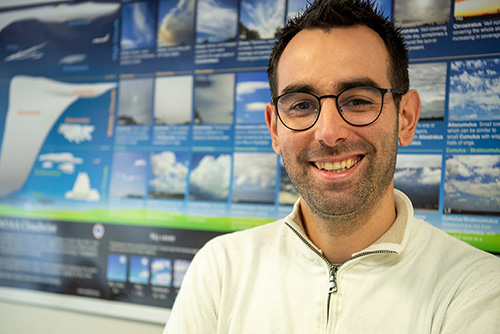
As a child, he dreamed of becoming a storm chaser. Eventually, after completing his PhD in 2018, Pierre Pouzet became a geographer. Following several postdoctoral positions, he took up a post as a senior lecturer at the Institut supérieur de l’électronique et du numérique in 2022, before joining the University of Angers at the start of the 2024 academic year.
The young lecturer and researcher has just secured funding from the French National Research Agency for his HiStoTracks project, short for ‘Trajectories of historical storms in the face of climate change within coastal socio-ecological systems’. “The idea is to find out whether, over the last millennium, we can observe a change in the trajectories of storms that have hit France,” explains the member of the Planetology and Geosciences Laboratory. “And what are the factors behind these variations ?”
Written and environmental archives
Whilst meteorological data for the last century is relatively easy to find, the task becomes more complicated as we go further back in time. Pierre Pouzet will search for traces of significant events in written archives (accounts of shipwrecks, insurance claims, etc.) and environmental archives (sediment cores, tree ring data, etc.). “The aim is to build a large spatialised database. From there, we will be able to observe whether there have been any changes, what may have influenced them in terms of climate and oceanography, and work on developing a model that will enable us to identify medium-term trends. We know that in the future, we will see an increase in tropical storms. But what about in our latitudes ? We are using the past to project into the future, by identifying the coastal areas that will be most likely to be exposed,” summarises Pierre Pouzet.
For this four-year project, which will conclude in March 2030, Pierre Pouzet will be collaborating with Meryem Mojtahid, Cyril Fleurant and Grégoire Maillet, lecturers and researchers at the LPG, Johan Vincent, a historian at Temos (University of Angers), Ayyoub Frifra and Mohamed Maanan, geographers at LETG (University of Nantes), and Olivier Planchon and Albin Ullmann, climatologists at Biogéosciences (University of Burgundy/CNRS). The €313,000 grant awarded by the ANR will be used in particular to fund a PhD in geography, due to commence in the autumn term of 2026, a research engineer post in history and a postdoctoral position in computer science to work on the modelling aspect.
Published on March 3rd, 2026