

Wind, rain, sea level rise… what if the cumulative erosion over the last million years were playing a role in the earthquakes in Brittany?
Plate tectonics does not fully explain why earthquakes occur far from plate boundaries. ANR EroSeis project suggests that erosion may play a role in this phenomenon.
First proposed in the 1960s, the theory of plate tectonics remains valid today : it explains the origins of tectonic activity, such as earthquakes. Broadly speaking, this theory states that the Earth’s outer layer is fragmented into tectonic plates. These plates can slide past one another, drift apart or collide. As a result, stress builds up at their boundaries and is released during earthquakes. But there is a catch. Earthquakes, sometimes major ones, occur far from plate boundaries, in areas thought to be calm… What is happening there?
This question has occupied the scientific community for several decades, without any precise theory having been validated. Yet a better understanding of the processes behind these earthquakes would enable us to better anticipate the risks. “There is no theoretical model that allows us to explain why there are earthquakes in Brittany or even in southern Australia,” points out Stéphane Mazzotti, a professor at the University of Nantes and at LPG. “There are many hypotheses, and we have chosen to explore a rather outlandish one with ANR EroSeis projec t: what if it were erosion?”
Erosion is a natural phenomenon: under the influence of rain, wind or human activity, rock breaks down (into fragments ranging in size from boulders to grains of sand) and these fragments are carried out to sea. For example, storms erode coastlines, whilst wind and rain erode mountain ranges, and so on. “The role of long-term erosion on seismic activity has already been demonstrated at plate boundaries,” explains Stéphane Mazzotti. “We know that it influences seismicity in mountain ranges such as the Himalayas. In Taiwan, we observe peaks in seismicity during typhoons, linked to significant erosion during these extreme events. ” The cause : isostatic rebound. Indeed, when a region is eroded, the fragments are carried away and the weight of the Earth’s crust decreases locally. In response, the region rises, much like a boat that rises to the surface if its weight is reduced. “This rebound generates stresses in the region, just like plate tectonics,”.
The originality of this project lies in testing this hypothesis not at plate boundaries but within them, in what is known as the ‘intraplate’ domain. “Some of my colleagues were already collaborating with Australian scientists, so we came up with the idea of testing our hypothesis in two areas : western France (the Pyrenees and Brittany) and southern Australia,” explains Stéphane Mazzotti.
Why is this significant? Although both regions are located within the same tectonic plate, they are very different: climate, erosion rates, seismicity rates… there are many factors that set them apart. “This comparison allows us to minimise the influence of other factors affecting seismicity,” the researcher continues. “Unfortunately, due to Covid-19 and personal issues affecting the project leaders in Australia, we were unable to carry out our fieldwork in Australia and have refocused the study on France.”
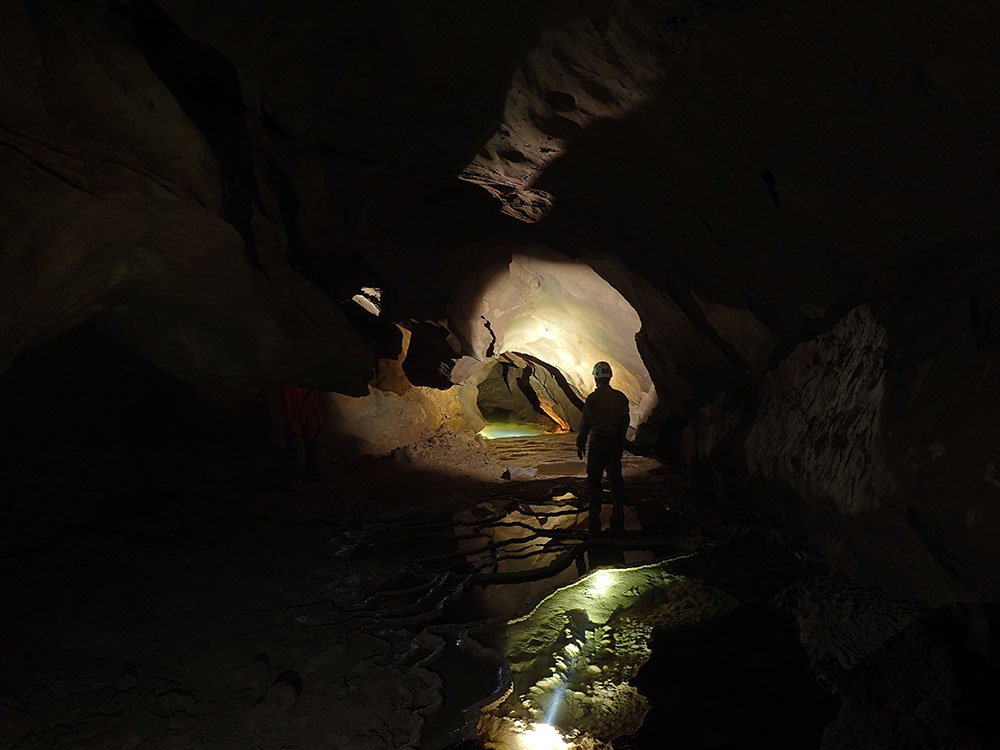
From 2022, the team will begin fieldwork in the Pyrenees and the Armorican Massif. The aim? To quantify the rate of erosion in both regions. To do this, the scientists are sampling sediments – those fragments of rock resulting from erosion – in order to estimate when they were deposited. “In the Armorican Massif, we collected river sand,” says Stéphane Mazzotti. “In the Pyrenees, the sampling conditions were unusual: we also collected samples from caves during caving expeditions. A first for me!”
Back in the laboratory, a lengthy process of chemical analysis begins. The samples are purified using highly corrosive acids to isolate a single mineral (quartz), which is then ground into a powder. These powders are analysed at the Particle Accelerator for Earth Sciences, the Environment and Risks (ASTER) in Aix-en-Provence. “These measurements enable us to calculate the rate (or speed) of erosion in our study areas,” adds Stéphane Mazzotti. “In the Armorican Massif, the team has shown that it ranges from 5 to 25 metres per million years.”
Finally, we need to test the initial hypothesis: does erosion contribute to seismicity in these regions? The team calculates isostatic rebound, as Stéphane Mazzotti explains: “We have developed a numerical model that incorporates all our knowledge of the region: geology, sedimentary basin thickness, local heat flow, and so on. This allows us to estimate the uplift and stresses caused by erosion.” In the Armorican Massif, uplift is 8 to 14 m per million years inland and 4 to 8 m per million years along the coast. “These results – along with preliminary research on earthquakes – suggest that long-term erosion may be a factor in deformation and seismic activity in stable continental regions.”
These findings now need to be supplemented. In parallel with the project, two PhD theses have been devoted to similar studies in the Alps and the Paris Basin, which will serve as a basis for comparison to better understand the effects of erosion within the plate. “We would like to launch a project covering the whole of mainland France and neighbouring Western Europe,” says Stéphane Mazzotti. “The aim is to incorporate the effect of erosion into seismic hazard calculations for the next update of the seismic hazard map in France.”
> Bibliographic reference : https://pubs.geoscienceworld.org/gsa/geology/article/51/8/733/623835/Impact-of-long-term-erosion-on-crustal-stresses
This research was funded in whole or in part by the French National Research Agency (ANR) under the ANR EROSEIS – AAPG2020 programme. This paper has been produced and funded under the ‘Science With and For Society – Scientific, Technical and Industrial Culture’ call for proposals for JCJC and PRC projects within the 2020 generic calls for proposals (SAPS-CSTI JCJC and PRC AAPG 20).
> Article written by Anaïs Maréchal and published in CNRS Le Journal
Published on March 25th, 2026