

Potential health risks associated with urban farming: the case of the town of Dschang in Cameroon
In Dschang, the illegal dumping of household waste and unregulated artisanal activities (particularly metalworking) have led to soil contamination by trace elements (Cr, Cu, Pb, Zn), posing a risk to human health due to the inhalation of soil dust and the consumption of food crops grown near sources of pollution.
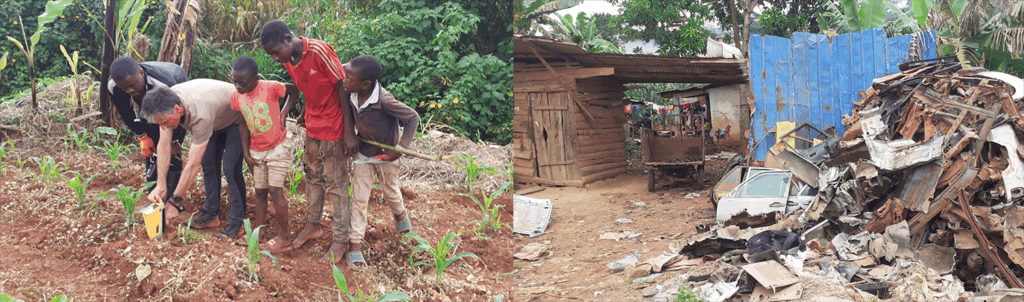
Like most African cities, Dschang (population 200,000, Cameroon) has experienced significant demographic and economic growth over the past two decades, and its population is expected to double over the next twenty years. This expansion is accompanied by an intensification of human activities and the production of effluents and waste of all kinds, including those from artisanal and domestic activities. Some of this waste contains trace elements (TE) such as As, Cd, Cr, Cu, Hg, Ni, Pb and Zn, which contaminate the soil.
Beyond environmental pollution, there are health implications for the population due to the inhalation of dust and the consumption of contaminated food. Informal food crops are spread throughout the city, particularly near artisanal activities (e.g. metalworking) or near fly-tipping sites. Furthermore, cultivated soils are enriched with unregulated organic matter, notably compost derived from urban waste.
The spatial distribution of heavy metals in soils in the town of Dschang was investigated to determine their origin (geogenic vs. anthropogenic). Soils from 71 sites (with surface analyses supplemented, for some sites, by analyses at different depths) were analysed using a portable X-ray fluorescence spectrometer (pXRF). Soils from sites associated with metal-related activities showed the highest levels of contamination (average concentrations in mg/kg: As, 8.2; Cr, 213.7; Cu, 201.8; Pb, 97.4; Zn, 838.0), followed by domestic waste dumps and agricultural plots. The decrease in TE concentrations with depth (particularly for Zn) supports the hypothesis of an anthropogenic origin (compared to the pedogeochemical background of the control sites). The geostatistical approach using the upper vibrissal method underestimates the health risk associated with the consumption of crops from several sites.
More specifically, 87.32%, 49.30% and 47.89% of sites exceeded the reference value for food production (based on the guideline values proposed by the Ile-de-France Regional Health Agency) for Cr, Zn and Cu, respectively. Our study highlights the need to use methods based on health risks, particularly for sensitive land uses such as food production.
Meanwhile, a recent meta-analysis conducted by Hou et al. (2025) indicates that 16% of the world’s soils used for food production are contaminated with TE (based on 800,000 analyses), posing a high risk to public health (0.9 to 1.4 billion people living in these regions) and the environment, the situation on the African continent remains poorly documented. The aim will be to extend this work to other cities in Cameroon and to compare the results with those from other countries (partnerships with Côte d’Ivoire – the ACCAO consortium – and Senegal).
Bibliographic reference : Lekemo, D., Lebeau, T., Amani, I., Kenne, E. R., Tsafack, H. N., Gaudin, P., & Temgoua, É. (2025). Geostatistical and Food Risk Assessment of Soils Contaminated by Trace Elements in the City of Dschang (Cameroon). Urban Science, 9(11), 467. https://doi.org/10.3390/urbansci9110467
Published on March 25th, 2026