

Gaining a better understanding of the impact of trawling on the seabed
For several years now, the Mediterranean has been a source of inspiration for research projects at the University of Angers and the LPG. Following in the footsteps of Meryem Mojtahid, who studied climate-related challenges, and Maxime Pontié, who focuses on marine pollution, it is now Christine Barras’s turn to explore this issue.
Impec project, led by Christine Barras, received initial funding of €124,000 from the OFB in 2020 to develop tools for assessing the quality of deep-sea ecosystems in relation to trawling. It was awarded a further €120,000 in funding in December 2025 for a three-year period.
“Off the Mediterranean coast, trawling has a major impact,” says Christine Barras. “This fishing method has been in use since the 14th century and saw significant growth with industrialisation in the late 19th century. Data from Ifremer (the French Research Institute for Exploitation of the Sea) allows us to track the movements of vessels, and thus to estimate abrasion, that is to say, the disturbance of the environment. But we do not know how the fauna reacts because it is an area that is more difficult to access than the coast, and also larger.”
The importance of foraminifera
A trawler is equipped with two metal panels at the front that penetrate deep into the sediment. As the boat moves forward, the panels spread apart and the fauna living on the surface of the sediment (macrofauna, meiofauna, mega-epifauna) and the fish are trapped in the net, also known as a trawl. This method of fishing leads to increased mortality among large or slow-moving organisms, and also indirectly disturbs the sediment (mixing of the sediment, penetration of oxygen to greater depths, acceleration of the mineralisation of organic matter).
“This fishing is not a leisure activity; it serves to feed the population,” says Christine Barras. “However, we need to strike a balance between protecting the environment and meeting an economic need. It is estimated that between 89 and 96 per cent of the area of the habitats studied in the Gulf of Lion has been degraded, altered or even lost.”
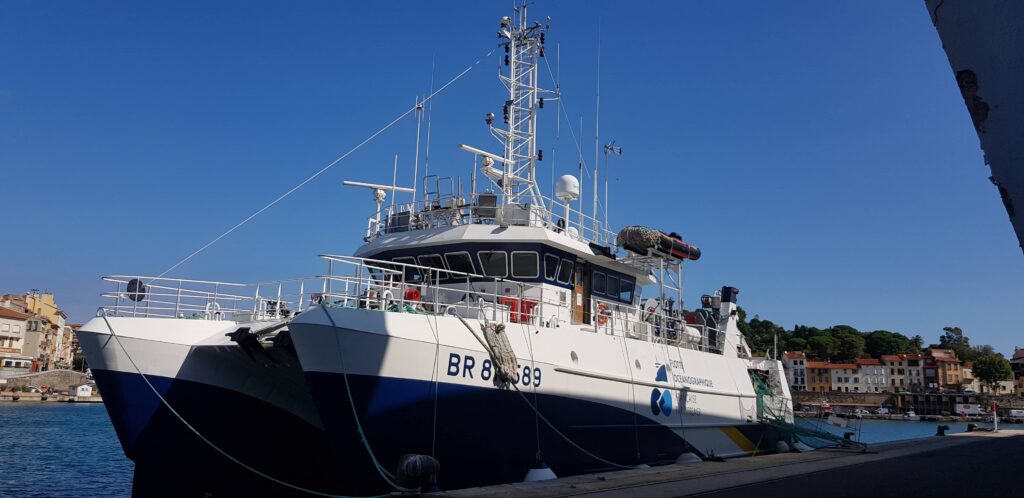
The Pagure is a camera-equipped vehicle used to take photos and videos of the seabed. Christine Barras therefore boarded the L’Europe in April 2021 for a 21-day oceanographic mission, funded by the French Oceanic Fleet, alongside technicians, researchers and engineers from the project’s partner organisations. These scientists sampled two study areas at depths of 80 and 100 metres using a vehicle equipped with cameras, corers and a sediment bucket to observe the fauna and foraminifera. These tiny single-celled organisms, preserved in the sediment, enable us to study how environmental conditions evolved before fishing intensified.
These indicators, by providing information on their sensitivity to trawling pressure, could be useful for monitoring deep-sea habitats. “We still need to examine the samples from the second area and carry out statistical analyses to compare our data and validate certain hypotheses. Other researchers from the LPG and partner laboratories will also be looking at the geochemistry of the sediment, its grain size distribution, and will study environmental DNA. These results will be used to advise the OFB on how to monitor the health of the continental shelf in relation to the impact of fishing.”
> Impec project partners : UMR CNRS Lecob (Laboratory of Ecogeochemistry of Benthic Environments) at Sorbonne University & UMR CNRS Ifremer IRD Marbec (Marine, Biodiversity, Exploitation and Conservation) at the University of Montpellier.
> Article published on the University of Angers website in early February 2026
Published on March 25th, 2026