

Oceanographic expedition off the coast of Mozambique and South Africa in spring 2026
Meryem Mojtahid, a paleoclimatologist at the “Laboratoire de Planétologie et Géosciences”, is set to embark on a voyage off the coasts of Mozambique and South Africa this spring to study climate variations. In the meantime, she visited a secondary school in Avrillé to talk about her research.
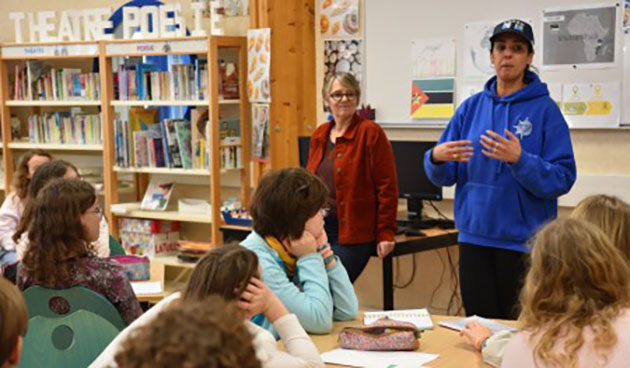
When speaking to secondary school pupils, using humour can be a double-edged sword. So, when Meryem Mojtahid mentions the difference between the carrot we eat and the one we use to collect sediment, she’s got them hooked: Class 5D at Clément-Janequin Secondary School is listening intently.
The LPG researcher outlined the CHARM research project to them, which she is coordinating and which is funded by the French Oceanographic Fleet: around a hundred scientists, representing ten nationalities and 25 different institutions, will set sail in early May aboard the Marion-Dufresne for a month-and-a-half-long expedition. Their mission is to analyse climate variations over the past 10,000 – or even 20,000 – years in the Southern Hemisphere by collecting sediment samples off the coasts of Mozambique and South Africa.
Alongside this research project, several meetings with primary and secondary school pupils from the Pays de la Loire region are being organised this year, such as the one on Thursday 29 January, in partnership with the science outreach association Culture Biome.
Foraminifera under the microscope
Once the presentation was over – complete with the unveiling of a Lego model of the boat – the pupils were free to ask all sorts of questions: “Why choose Mozambique? What if you get seasick? Will there be any diving? Does the boat use a lot of fuel? How do you feel about going on an expedition?”
To answer these, Meryem is joined by Emmanuelle Geslin, an oceanographer at the LPG. The two researchers then explained the role of foraminifera, micro-organisms found in the oceans that serve as indicators of both past climates and the ecological health of the marine environment. The young scientists were able to observe them using a binocular magnifying glass, a type of microscope, before taking part in other workshops on climate, biodiversity and the weather, led by Marine Pépin from Culture Biome.
The researchers from the LPG will return to Clément-Janequin secondary school in April to engage with the pupils once again. Then, once on board, they will answer their questions live. For its part, Culture Biome plans to produce a documentary and a photographic exhibition.
>Article published by the University of Angers in February 2026
Published on February 18th, 2026